


The Manufacturers Association of Nigeria (MAN) has reiterated its support for reforms aimed at modernising tax administration, improving revenue mobilisation and strengthening fiscal sustainability, stressing that tax reforms should encourage enterprise, compliance and investment rather than create fresh uncertainty or impose unintended burdens on businesses.
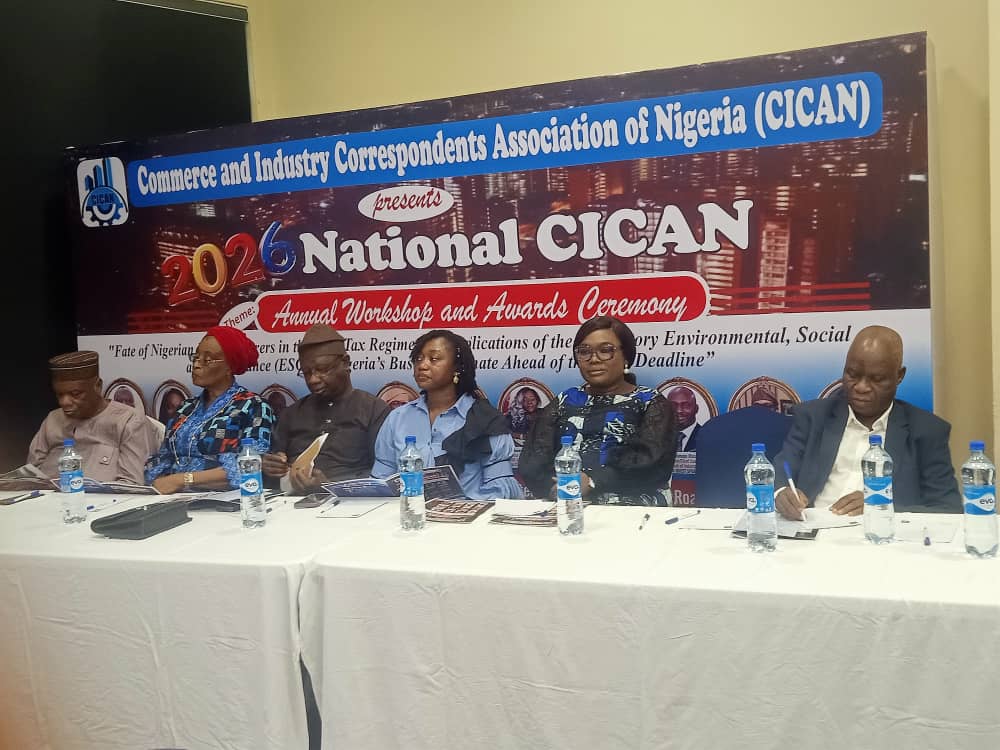
The Director-General of MAN, Mr Segun Ajayi-Kadir, stated this while delivering his goodwill message at the 2026 National Annual Workshop and Awards of the Commerce and Industry Correspondents Association of Nigeria (CICAN), held in Lagos.
The workshop was themed, “Fate of Nigerian Manufacturers in the New Tax Regime and Implications of Mandatory Environmental, Social and Governance (ESG) on Nigeria’s Business Climate Ahead of the 2030 Deadline.”
Ajayi-Kadir, who was represented by Mrs Victoria Onuoha, Acting Head of MAN’s Corporate Affairs Division, disclosed that the association was actively involved in the formulation of the new tax laws and made contributions to ensure that the reforms deliver meaningful benefits to the productive sector.
He maintained that successful implementation of the reforms requires transparency, consistency and predictability. He also reiterated MAN’s opposition to the unwarranted retrospective application of the 2025 Nigeria Tax Laws, warning that implementation must respect established legal principles and applicable transitional provisions.
Ajayi-Kadir emphasised that the Environmental, Social and Governance (ESG) dimension of the workshop was equally important, noting that MAN recognises environmental sustainability, social responsibility and sound corporate governance as essential to modern industrial competitiveness.
“Our advocacy has consistently emphasised practical, science-based approaches and balanced regulatory frameworks that protect the environment while safeguarding investment, employment and productive capacity.
“Our commitment goes beyond advocacy. MAN established a Green Manufacturing Unit to support members in adopting sustainable industrial practices. Also, through the Industrial Energy Efficiency (IEE) and Resource Efficient and Cleaner Production (RECP) Project in Nigeria, with its Project Management Office domiciled in MAN, progress has also been made in promoting energy efficiency, resource optimisation, cleaner production and sustainability awareness,” he stated.
He explained that these interventions demonstrate that environmental responsibility and industrial competitiveness can advance together, adding that sustainable practices, when properly supported, can reduce costs, minimise waste, improve efficiency and create access to emerging markets.
He, however, warned that ESG frameworks developed in other economies cannot always be adopted wholesale, stressing that Nigeria’s approach must reflect local realities, industrial capacity, infrastructure and the economic conditions under which manufacturers operate.
According to him, ESG compliance must be supported by realistic transition timelines, clear regulatory guidance, technical assistance, affordable financing and appropriate incentives, particularly for small and medium-scale manufacturers.
“Our objective should be meaningful environmental outcomes without undermining the industries we seek to make sustainable. Strong ESG performance can also build trust among regulators, investors and consumers, while enhancing the reputation of Nigerian manufacturing,” he said.
The MAN Director-General acknowledged that the collective responsibility was to ensure that tax reforms and sustainability requirements became instruments of industrial transformation rather than additional obstacles to growth. He added that this required policy coherence, continuous engagement and stronger collaboration among government, regulators, financial institutions and the organised private sector.
He also reaffirmed MAN’s nonpartisan position as political activities gather momentum ahead of the next electoral cycle, emphasising the need to keep the economy at the centre of national development, given the far-reaching implications of the policies proposed by those seeking public office for the survival, growth and competitiveness of industries.
Ajayi-Kadir urged the media, particularly commerce and industry correspondents, to subject the economic programmes of all candidates to rigorous and constructive scrutiny.
“Nigerians deserve clear, practical and measurable commitments on strengthening the productive sector, promoting Made-in-Nigeria products, addressing infrastructure and energy challenges, and creating an enabling environment for industrial growth. The media must ensure that issues affecting the real sector remain prominent in national conversations and that manufacturers’ perspectives are adequately represented,” he added.
He reaffirmed MAN’s commitment to constructive engagement with the government and all stakeholders towards building a resilient, competitive and sustainable manufacturing sector.
“We aspire to an economy where tax reforms protect productive capacity, sustainability requirements inspire innovation, and public policies give businesses the confidence to invest, produce and create jobs,” he said.
