


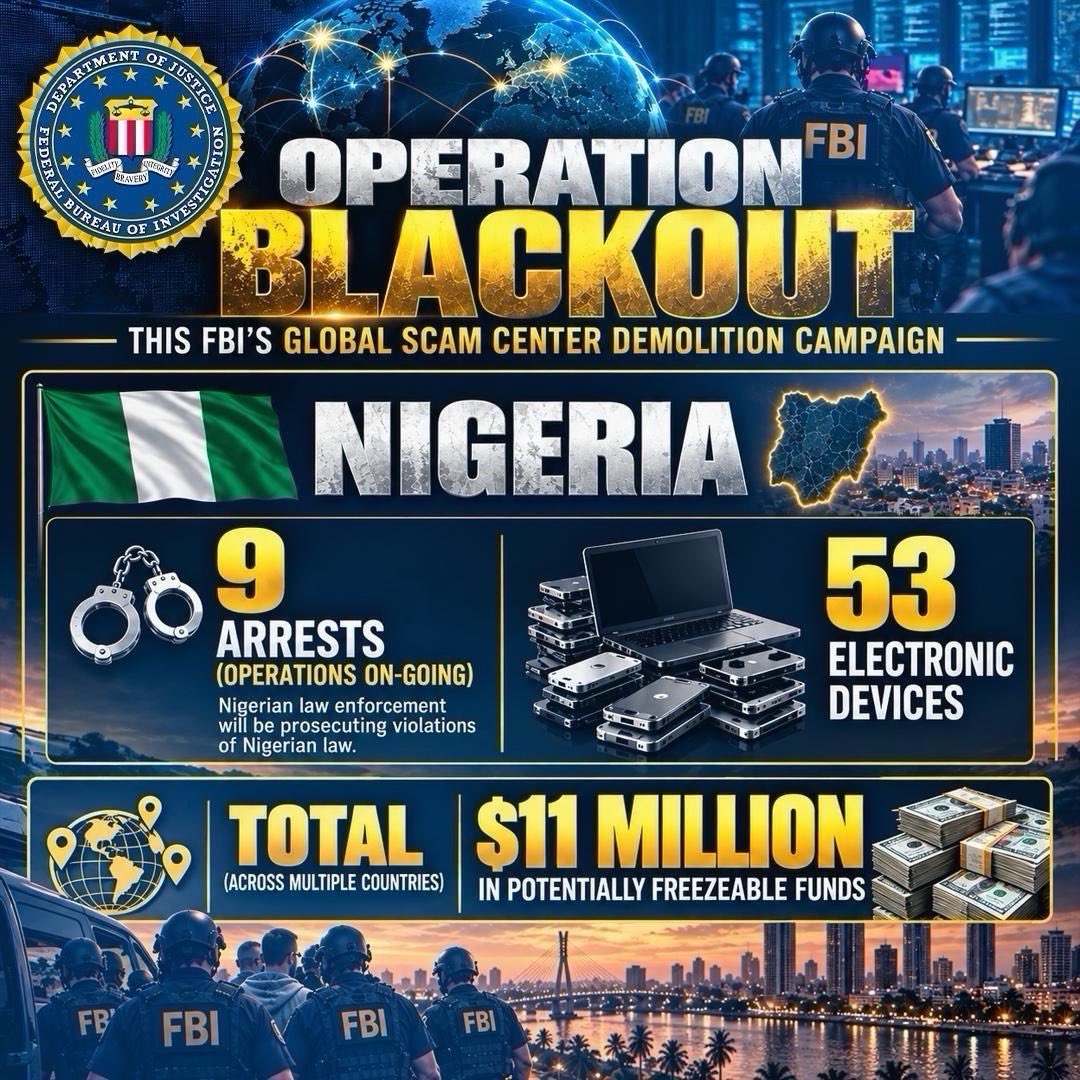
The Federal Bureau of Investigation (FBI) has arrested nine suspects in Nigeria and seized 53 electronic devices as part of an international crackdown on cybercriminal networks accused of defrauding victims across borders.
FBI Director Kash Patel disclosed this in a post on his verified X account on Sunday, saying investigators and private-sector partners had identified more than $11 million in potentially freezable funds across multiple countries.
The operation formed part of a wider international enforcement effort targeting online scam networks operating in West Africa and other regions. The US Department of Justice described the coordinated campaign as “Joint Disruption Week.”
In his post, Patel said: “Operation Blackout is taking the fight directly to the international cybercriminal networks stealing billions from Americans.”
He said the Nigerian operation resulted in nine arrests and the seizure of 53 electronic devices, while more than $11 million in potentially freezable funds was identified across multiple countries.
“These scam centers exploit innocent victims, steal life savings, and operate across international borders believing they are beyond the reach of law enforcement,” Patel said.
“They’re wrong,” he added.
The FBI director commended Nigerian law enforcement agencies and their partners in London for their cooperation, saying: “Thanks to Nigerian law enforcement and our partners in London for their outstanding cooperation.”
He also warned cybercriminals targeting Americans from overseas that “JUSTICE WILL FIND YOU.”
The wider enforcement effort resulted in 28 arrests across Nigeria and Ghana. In Ghana, authorities arrested 19 people and seized 303 electronic devices during an operation in Sasaabi, a suburb of Accra. They also identified 117 suspected human trafficking victims awaiting repatriation to Nigeria and 89 victims of online scams who reportedly lost about $8.3 million.
According to the US Department of Justice, the disrupted schemes included law enforcement impersonation, digital arrest extortion, fraudulent cryptocurrency investment schemes, also known as “pig butchering”, and other forms of online fraud targeting victims around the world.
