


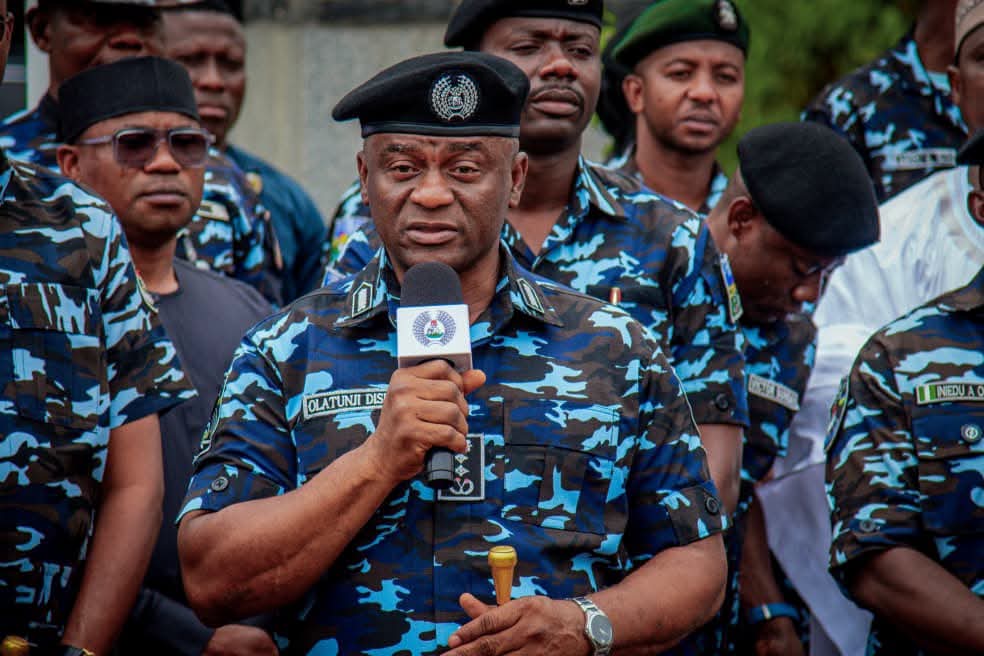
Since assuming office as the Inspector-General of Police (IGP), Olatunji Rilwan Disu has pursued an ambitious agenda aimed at repositioning the Nigeria Police Force as a more accountable, professional, and community-oriented institution.
Appointed by President Bola Ahmed Tinubu, the police chief has distinguished himself through a leadership style that combines operational decisiveness with institutional reform, earning commendation from within the Force and among sections of the public.
At the heart of his vision is a policing philosophy that places citizens at the centre of security. Rather than viewing law enforcement solely through the lens of authority, IGP Disu has consistently promoted collaboration, transparency, and shared responsibility, insisting that effective policing can only be achieved when communities and the police work in partnership. His oft-repeated message that “security is everyone’s business” reflects a broader strategy of building public trust while encouraging citizens to become active stakeholders in safeguarding their communities.
One of the defining pillars of his administration is the drive towards community policing and the decentralisation of law enforcement. Recognising the limitations of an overly centralised policing structure, the IGP has openly supported the implementation of state policing, arguing that officers who understand the culture, language, and unique security dynamics of their communities are better positioned to prevent crime and respond swiftly to emerging threats.
Beyond advocacy, he has demonstrated strategic foresight by establishing specialised internal committees to develop practical frameworks for the eventual implementation of state policing. The committees are drawing on comparative studies and best practices to address issues of training, accountability, operational standards, and sustainable funding ahead of any transition.
The Inspector-General has also prioritised restoring confidence in the Nigeria Police Force through greater transparency and institutional accountability. By strengthening communication with the public and promoting evidence-based engagement, his administration seeks to counter misinformation while rebuilding citizens’ confidence in law enforcement institutions.
This approach has been complemented by deliberate efforts to promote openness within the Force and reinforce ethical policing at every level.
Perhaps no area better illustrates IGP Disu’s commitment to reform than his uncompromising stance against police misconduct.
Determined to restore discipline and professionalism, he has made accountability a central pillar of his leadership. Commissioners of Police across the country have been unequivocally warned that illegal detention, extortion, corruption, abuse of office, and other forms of misconduct will attract severe sanctions, including dismissal and prosecution. Through strengthened oversight mechanisms, including the deployment of the X-Squad and other internal monitoring units, his administration has intensified efforts to curb impunity within the Force while reinforcing public confidence in police accountability.
On the operational front, the IGP has demonstrated equal resolve in confronting Nigeria’s complex security challenges. Under his leadership, the Nigeria Police Force has intensified coordinated operations against banditry, kidnapping, terrorism, and other violent crimes across the country. His decision to launch a 14-day clearance operation targeting criminal hideouts and forest enclaves in Benue State exemplifies his readiness to deploy decisive tactical measures in response to emerging security threats and restore peace to affected communities.
Beyond conventional policing, IGP Disu has broadened the role of the Force in protecting Nigeria’s critical national assets. Recognising the economic implications of attacks on public infrastructure, he strengthened collaboration with the Ministry of Power to combat the vandalisation of electricity infrastructure and the growing menace of power theft. The initiative reflects a broader understanding that safeguarding critical infrastructure is essential to economic development and national security.
Internally, the welfare and professional development of police personnel have received renewed attention under his administration. By ensuring timely promotions and recently decorating 30 newly promoted senior officers, including Assistant Inspectors-General of Police and Commissioners of Police, the IGP has reinforced merit-based career progression while boosting morale across the Force.
Complementing these efforts is the introduction of mandatory weekly professional lectures in divisional, area, and state commands, designed to keep officers abreast of evolving legal frameworks, investigative techniques, emerging technologies, and contemporary policing standards.
While every leadership transition within the Nigeria Police Force inevitably generates discussions about institutional continuity and broader structural reforms, IGP Disu’s extensive experience in intelligence, investigation, and tactical operations has enabled him to settle quickly into office and provide steady leadership during a challenging period.
His emphasis on accountability, operational efficiency, institutional reform, professionalism, and community partnership has helped shape a policing model that is increasingly responsive to the expectations of a modern society.
As the Nigeria Police Force continues its transformation journey, many observers believe the reforms championed by IGP Olatunji Rilwan Disu represent a significant step towards building a more transparent, efficient, and people-centred police institution—one that not only enforces the law but also earns the confidence and cooperation of the citizens it exists to serve.
Collins Iwuoha wrote from Lagos
