


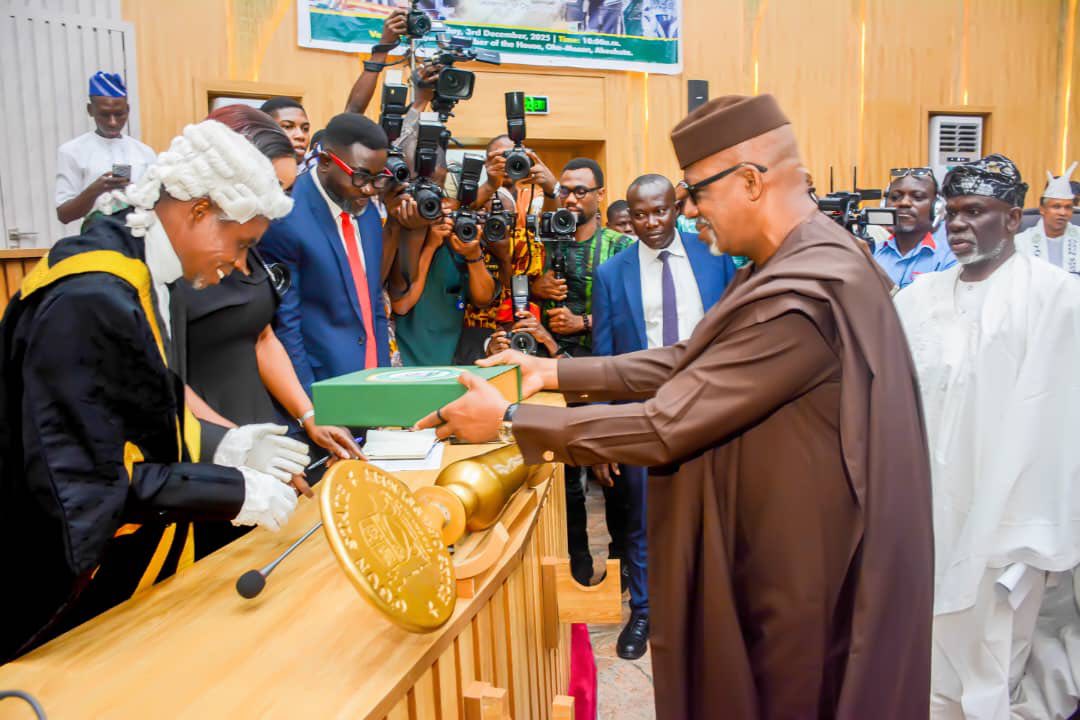
The Ogun State Government has proposed a total expenditure of ₦1.668 trillion for the 2026 fiscal year, representing a 63 percent increase from the 2025 budget of ₦1.054 trillion.
Governor Dapo Abiodun presented the Appropriation Bill, tagged “Budget of Sustainable Legacy,” before the State House of Assembly on Tuesday at Oke-Mosan, Abeokuta.
He said the proposal allocates ₦624.76 billion (37%) to recurrent expenditure and ₦1.044 trillion (63%) to capital projects.
Providing a breakdown, the Governor listed key cost components as follows: Personnel Costs – ₦167.92bn; Consolidated Revenue Charges – ₦65.80bn; Public Debt Charges – ₦99.98bn; Overhead Costs – ₦291.06bn; and Capital Expenditure – ₦1.044trn.
Abiodun projected ₦509.88bn in Internally Generated Revenue (IGR) for 2026 – ₦250bn from the Ogun State Internal Revenue Service and ₦259.80bn from Ministries, Departments and Agencies (MDAs). Statutory allocation from the Federal Government is expected to contribute ₦554.81bn, while ₦518.90bn is anticipated from capital receipts, including loans and grants.
Infrastructure takes the largest share of the 2026 budget with ₦526.15bn (32%), followed by Education with ₦275.40bn (17%), and Health, ₦210.59bn (13%). Other allocations include: Housing & Community Development -₦199.96bn (10%), Social Protection – ₦72.82bn (4%), Recreation, Culture & Religion – ₦42.24bn (3%), Public Order & Safety – ₦36bn (2%), Agriculture & Industry – ₦40.54bn (2%), Legislature – ₦33.67bn (2%), Judiciary – ₦15.70bn (1%), Economic Affairs – ₦7.45bn (0.4%), Statewide Expenditure – ₦129.68bn (8%).
The Governor said the 2026 budget would prioritise the completion of major projects under the administration’s ISEYA development pillars, focusing on initiatives that generate revenue, create jobs and align with both national development plans and President Bola Tinubu’s Renewed Hope Agenda.
Reviewing the 2025 Budget of Hope and Prosperity, he noted that as of September 30, the State achieved 60 percent of its pro-rata expenditure target and 53 percent of its projected revenue. He said the budget helped reduce inequality and improved quality of life across various sectors.
The Governor disclosed that Ogun’s economy has expanded to an estimated Gross Domestic Product (GDP) of ₦17 trillion, while IGR increased from ₦52bn in 2020 to nearly ₦192bn in 2024, with a projection of ₦250bn in 2025.
He highlighted ongoing infrastructure investments, including the fully certified Gateway International Airport, now operating commercial flights between Ogun and Abuja. He added that the construction of the Kajola and Ijebu-Ode Inland Dry Ports will further boost exports, reduce transport costs and strengthen agro-processing and industrial growth.
Abiodun said his administration has constructed and rehabilitated over 1,500 kilometres of roads in six years—an achievement he described as surpassing the record of several previous administrations combined.
The Governor urged the Assembly to expedite passage of the bill and announced upcoming major events, including the Gateway Afrobeat Drum Festival and Ogun State’s 50th Anniversary celebrations slated for 2026.
Earlier, Speaker Rt. Hon. Oludaisi Elemide said the House had considered 19 bills in the outgoing year, 11 of which were passed into law, covering energy, education, local government administration and environmental management. He noted that the Assembly issued 56 resolutions across key sectors including security, finance, education and infrastructure.
The Speaker called for the establishment of a special court to enforce the State’s Anti-Land Grabbing Law, noting that the House resolved over 100 potentially disruptive disputes involving land, chieftaincy matters and community issues within the year.
Elemide commended the Governor for prompt payment of constituency allowances and the renovation of the Assembly Complex and requested additional electronic office equipment and more legislative staff to enhance productivity.
