


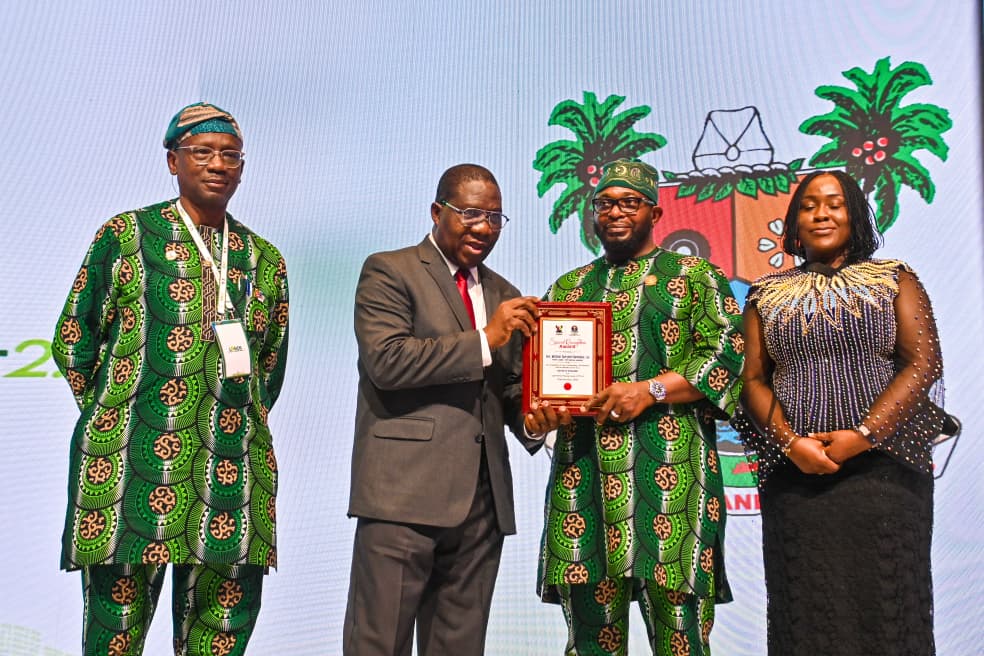
The Senate Leader, Senator Opeyemi Bamidele, has urged Lagos State to strengthen coordination between physical development plans, infrastructure budgets and project implementation to ensure that urban planning delivers measurable benefits to residents.
Bamidele made the call at the Lagos Physical Planning Summit 2.0, organised by the Ministry of Physical Planning and Urban Development, where he advocated closer integration of development planning, infrastructure investment and regional cooperation to promote sustainable urban growth.
Speaking on the theme, “Diagnosis to Delivery: Positioning Lagos for Strategic Regional Development and Priority Investment Agenda,” Bamidele said the future of Lagos would depend not only on the quality of its development plans but also on the commitment to finance, coordinate and implement them.
“The future of Lagos will depend not only on the quality of its development plans, but also on the determination with which those plans are financed, coordinated and implemented,” he said.
The Senate Leader proposed a Lagos-to-Southwest Spatial Development and Investment Compact to coordinate cross-border infrastructure, regional economic corridors, environmental resilience and investment opportunities among Lagos and neighbouring states.
He said the proposed framework would enable participating states to identify shared infrastructure priorities, coordinate regional planning and mobilise investments for projects that benefit communities across state boundaries.
According to him, the compact should bring together state governments, relevant federal institutions, planning authorities, infrastructure agencies, private-sector organisations, professional bodies and development partners.
Bamidele identified regional transportation and logistics, complementary economic corridors, cross-border urban planning, environmental resilience and regional investment mobilisation as priority areas for the proposed initiative.
He said the framework should establish clear mechanisms for project selection, funding, implementation responsibilities and performance measurement.
“It should begin with a jointly agreed priority project pipeline and a practical implementation roadmap rather than become another declaration of good intentions,” he said.
Bamidele called for closer coordination between Lagos and neighbouring states on transportation networks, housing, industrial development, warehousing and commercial districts to reduce congestion, improve freight movement and attract investment.
He cited the proposed Olokola Deep Sea Port in Ogun State, alongside rail expansion and other regional infrastructure projects, as opportunities to develop an integrated Lagos-Ogun industrial and logistics corridor.
The Senate Leader also urged Lagos to leverage the Electricity Act 2023 to attract private investment in power generation, distribution, renewable energy and independent electricity networks to support industrial estates, commercial centres, residential communities and technology clusters.
On the role of the National Assembly, Bamidele said lawmakers could contribute through legislation and oversight within their constitutional responsibilities, particularly in infrastructure development, environmental protection, transportation, urban resilience and intergovernmental cooperation.
He said federal and state institutions should strengthen coordination on projects that cross jurisdictional boundaries while respecting the constitutional responsibilities of each level of government.
Bamidele further advocated stronger regional cooperation among Lagos, Ogun, Oyo, Osun, Ondo and Ekiti states to harmonise transport planning, power infrastructure, industrial policies, tourism development and investment promotion.
He called for greater use of digital technology, improved land administration, transparent development regulations and effective public-private partnerships to support sustainable urbanisation.
The Senate Leader said physical planning should involve government agencies, legislators, professional bodies, the organised private sector, community leaders and traditional institutions to ensure that development policies reflect residents’ needs.
He urged relevant professionals, particularly town planners, to promote public awareness of planning and environmental regulations. He also called for collaboration with the Nigerian Institute of Town Planners and tertiary institutions to improve research, data collection and planning practices.
Bamidele said the ultimate goal should be a Lagos where residents spend less time in traffic, businesses operate more efficiently, housing is more accessible, flood risks are reduced and investment generates productive employment.
“We must connect physical planning to economic development, infrastructure investment to measurable public benefits, digital innovation to effective governance, and state-level priorities to regional cooperation,” he said.
He added that sustainable urban development required capable institutions, predictable regulations, transparent financing and sustained collaboration among governments, businesses, professional institutions, communities and development partners.
