


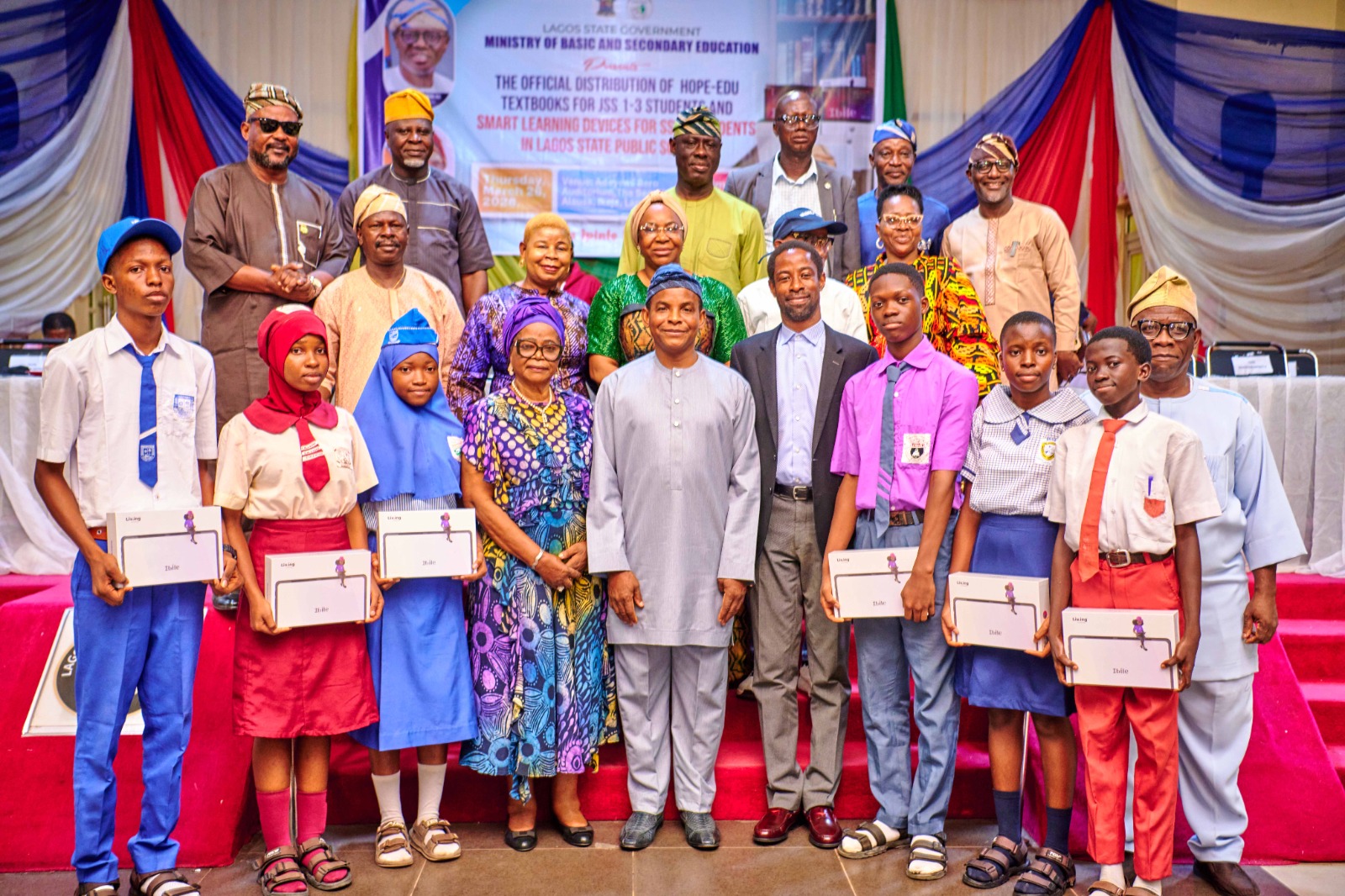
In a major push for technology-driven learning, Governor Babajide Sanwo-Olu has scaled up Lagos State’s Hope for Digital Education initiative with the rollout of digital tablets and textbooks to students in public secondary schools.
The initiative, which is part of the third pillar of the Governor’s T.H.E.M.E.S agenda, underscores the administration’s commitment to leveraging education and technology as critical drivers of a modern, knowledge-based economy.
According to a statement issued on Friday by the Public Relations Officer of the Lagos State Ministry of Basic and Secondary Education, Mr. Elias Olawale, the programme also aligns with the Federal Government’s National Hope Agenda, which prioritises human capital development and improved access to quality education.
Speaking on the rollout, Governor Sanwo-Olu said the initiative is designed to create equal opportunities for all learners across the state, regardless of background.
“We are enabling access, opportunity, and a future where every child can learn, grow, and succeed,” the governor said.
“Through this balanced approach of technological innovation and foundational literacy, we are positioning Lagos as a benchmark for educational excellence in Nigeria.”
Under the leadership of the Commissioner for Basic and Secondary Education, Mr. Jamiu Alli-Balogun, the initiative has evolved from a pandemic-era intervention into a comprehensive, statewide education reform programme.
Alli-Balogun explained that the government is deliberately combining digital innovation with traditional learning tools to ensure holistic academic development.
“Our goal is to integrate technology with foundational literacy so that students are not only equipped with digital skills but are also grounded in core academic knowledge needed to thrive in the 21st century,” he said.
The newly distributed Hope Digital Learning Tablets are embedded with data-enabled SIM cards powered by Liv.ing and supported by the Roducate platform, providing students with access to curriculum-aligned lessons, instructional videos, mock examinations, and life skills content.
Paired with simplified core textbooks, the initiative ensures uninterrupted access to quality learning resources, both within and outside the classroom, thereby reinforcing continuous learning.
Education authorities noted that the programme is already yielding measurable outcomes. Public secondary school students recorded an 80 per cent pass rate in the West African Senior School Certificate Examination (WASSCE) in 2021, with projections indicating further improvement as the initiative expands.
With over 600,000 students expected to benefit, the programme is also designed to promote inclusive education and incentivise excellence through performance-based rewards for students, teachers, and parents.
The state government maintained that the integration of digital learning tools with accessible textual resources will not only improve academic outcomes but also equip students with the skills required to compete in a rapidly evolving global landscape.
The expansion of the Hope for Digital Education initiative further reinforces Lagos State’s leadership in education innovation, setting a standard for other subnational governments across Nigeria.
