


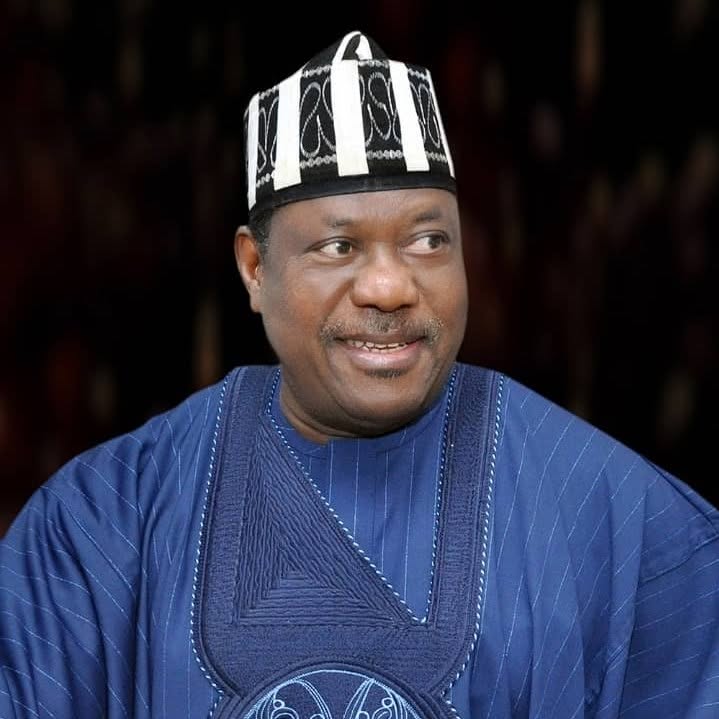
Secretary to the Government of the Federation (SGF), Senator George Akume, has disclosed that former Vice President Atiku Abubakar was among northern political leaders who supported the adoption of rotational presidency in the aftermath of the annulment of the June 12, 1993 presidential election.
Akume made the revelation in Abuja during a World Press Conference held as part of activities commemorating Nigeria’s 27th Democracy Day anniversary.
According to the SGF, the controversial annulment of the election widely believed to have been won by the late Chief Moshood Kashimawo Olawale Abiola triggered intense consultations among political leaders, culminating in an agreement to alternate presidential power between the North and the South in the interest of national stability and unity.
Recalling the deliberations that followed the political crisis, Akume said leaders of the Peoples Democratic Party (PDP) met in Kaduna under the leadership of the late Chief Solomon Lar and Alhaji Adamu Ciroma to chart a path forward for the country.
“It was a tough argument before the issue of rotational presidency was agreed on. At the end, we had to concede. We must do this. June 12 annulment had complicated the whole thing. It was finally agreed that we’ll be alternating between North and South.
“Atiku was one of the leaders at that meeting, which was convened by Chief Solomon Lar. He was part of that agreement,” Akume said.
The SGF explained that the power-sharing arrangement was conceived as a mechanism to heal political divisions created by the annulment and to foster a greater sense of inclusion among Nigeria’s diverse regions.
Describing the annulment of the June 12 election as one of the most painful episodes in Nigeria’s democratic history, Akume said the decision by the military government undermined the freely expressed will of Nigerians.
“Abiola won that election round and square. That election was annulled by the military government. It was very painful because the people spoke, and they spoke freely. They made their own choice,” he stated.
He stressed that one of the enduring lessons from the June 12 experience is the need to respect the sovereignty of the electorate and protect the sanctity of the ballot.
“The first lesson is that the voice of the people must always be supreme; it must be sacrosanct. That’s the beauty of democracy. We prefer the ballot to bullets,” he said.
Akume expressed confidence that Nigeria’s democratic institutions have matured sufficiently to prevent a recurrence of the events that followed the 1993 election.
“If an election is conducted very fairly, and one wins, no problem. The actors at the Independent National Electoral Commission are not young people; they were adults when this thing happened.
“If we were to take a poll at that time, over two-thirds of Nigerians would have condemned that act of annulment,” he said.
The SGF praised officials of the Independent National Electoral Commission (INEC), describing them as patriotic Nigerians committed to safeguarding the country’s democratic process.
“Fortunately for us, those at INEC are men of honour and integrity. They are well-read, patriotic Nigerians, and they are determined to make a difference. Never again would such happen in this country.
“You win, you win. When you lose, go back and prepare for another election. Look at the American example. President Trump lost to Joe Biden. He didn’t bring America down. He went back, prepared and came back and won. That’s the beauty of democracy,” Akume said.
Reflecting on Nigeria’s democratic journey, he noted that the country’s uninterrupted democratic rule since 1999 demonstrates a collective commitment to constitutional governance and political freedom.
“We have decided to embrace democracy. That is why, for 27 unbroken years, we are enjoying this freedom in a democratic setting. We love the values and the morals of democracy, and there is no system that is as beautiful as democracy,” he stated.
Akume also highlighted freedom of expression as one of the major gains of democratic governance.
“It is under a democratic system that you can insult your president and insult anybody and still go to bed, and you don’t receive a midnight knock on your door. Try it under a totalitarian regime,” he said.
He urged political actors across party lines to respect electoral outcomes, strengthen democratic institutions and place national interest above partisan considerations.
The SGF’s remarks come amid renewed national conversations on zoning and power rotation ahead of the 2027 general election, with political parties and stakeholders debating whether the presidency should remain in the South after President Bola Tinubu’s first term or return to the North.
Following the return to democratic rule in 1999, major political parties, particularly the Peoples Democratic Party (PDP), adopted an informal zoning and rotational presidency arrangement aimed at balancing power between the North and South and promoting national cohesion.
The debate over power rotation has resurfaced ahead of the 2027 elections, with supporters arguing that it fosters inclusiveness, while critics maintain that competence rather than geography should determine leadership selection.
